Safety of mmWave Radar Technology for Humans

Once only available to military and scientific use, today – the microwave spectrum (30-300GHz – abbreviated as mmWave) is increasingly used in commercial applications such as automotive radar, industrial sensors and high-speed communication. The high frequency waves come with a benefit of high image resolution and high information density, but tend to carry more electromagnetic energy. As a future surrounded with commercial radars seems more inevitable, this has raised public concern on the safety of these devices.
Ionizing Radiation
Ionization is the process where an atom or molecule loses an electron, either under external or internal processes. If hit by a high energy particle such as photon (an elementary electromagnetic particle) or proton (an elementary subatomic particle) an atom will lose an electron and become ionized. Given enough energy, an electromagnetic particle can break molecules, protein chains, chemical bonds in DNA and even cell tissue. The negative effects of such radiation are numerous, from cell damage, unwanted mutations, cell death, radiation poisoning and, eventually, cancer. 1
For an electromagnetic particle to be ionizing it’s energy must exceed 10eV(electronvolts). As the energy of the photon is directly linked to it’s frequency and wavelength – this means all electromagnetic radiation above 2.4 1015 Hz (2,4 PetaHertz) is ionizing and thus considered dangerous. Given that the commercial mmWave radars operate at 20-80 109 Hz (20-80GigaHertz) or around 0.1 millielectronvolt (meV) this places mmWave radiation 6 orders of magnitude safely under the danger line. Simply put, microwave radiation could never have enough energy to ionize an atom. From the perspective of ionization it is thus considered safe.

This is, however, not the only way electromagnetic radiation can cause harm.
Thermal effects
The other, more concerning, effect of mmWave radiation is its heating property. Due to the wavelength being comparable to macro objects (10mm – 1mm) the human body is capable of absorbing mmWave energy. The absorbed energy will dissipate in the body as heat – this is an effect similar in principle to a microwave oven.
Current global regulations and guidelines define the safe power levels devices can emit to prevent bodily harm.
1. International Commission on Non-Ionizing Radiation Protection (ICNIRP) 2
| General public | Occupational exposure |
|---|---|
| 10W/m2 | 50W/m2 |
2. United States Federal Communications Commission (FCC) 3
| General public | Occupational exposure |
|---|---|
| 10W/m2 | 50W/m2 |
Skin absorption
When exposed to mmWave radar radiation, the human body will reflect around 30-40% of the incident wave 4, the reflected energy is then detected by a radar and used to determine the position, movement and structure of the object. The rest, 60% of the energy will be absorbed.
Studies show that as much as 90% of energy is absorbed by the first two layers of the human skin – the epidermis and the dermis, with only a small amount penetrating into deeper tissue 5. It is further shown that at 60GHz, an incident wave of 50W/m2 will cause around ~1 °C of localized temperature elevation in the skin – amount that will exponentially decrease with tissue depth halving every ~5 mm.
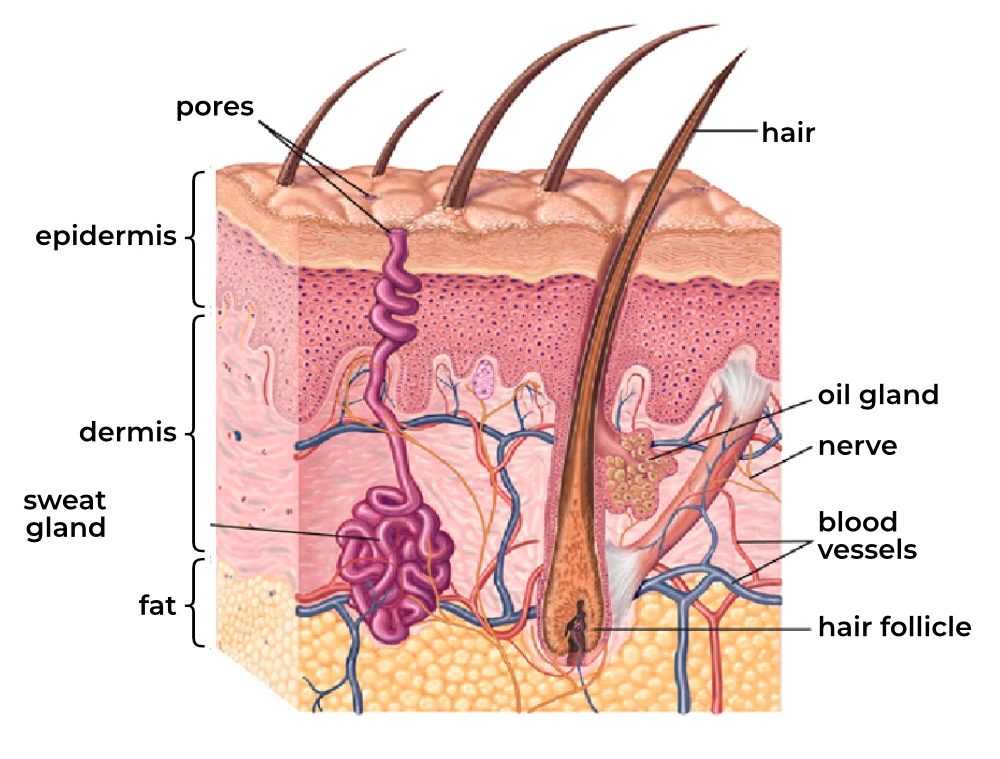
The term “radiation” might be intimidating by itself, but in the context of mmWave radar it is significantly less dangerous than taking a stroll on a sunny spring day.
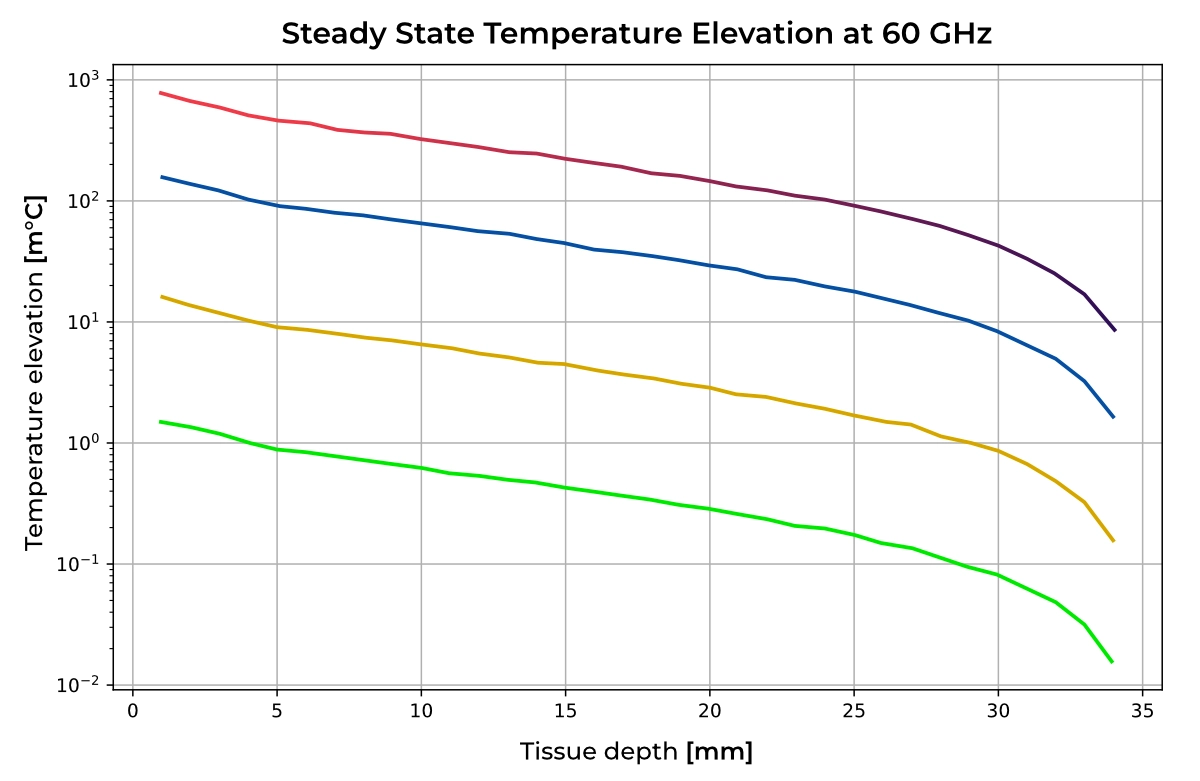
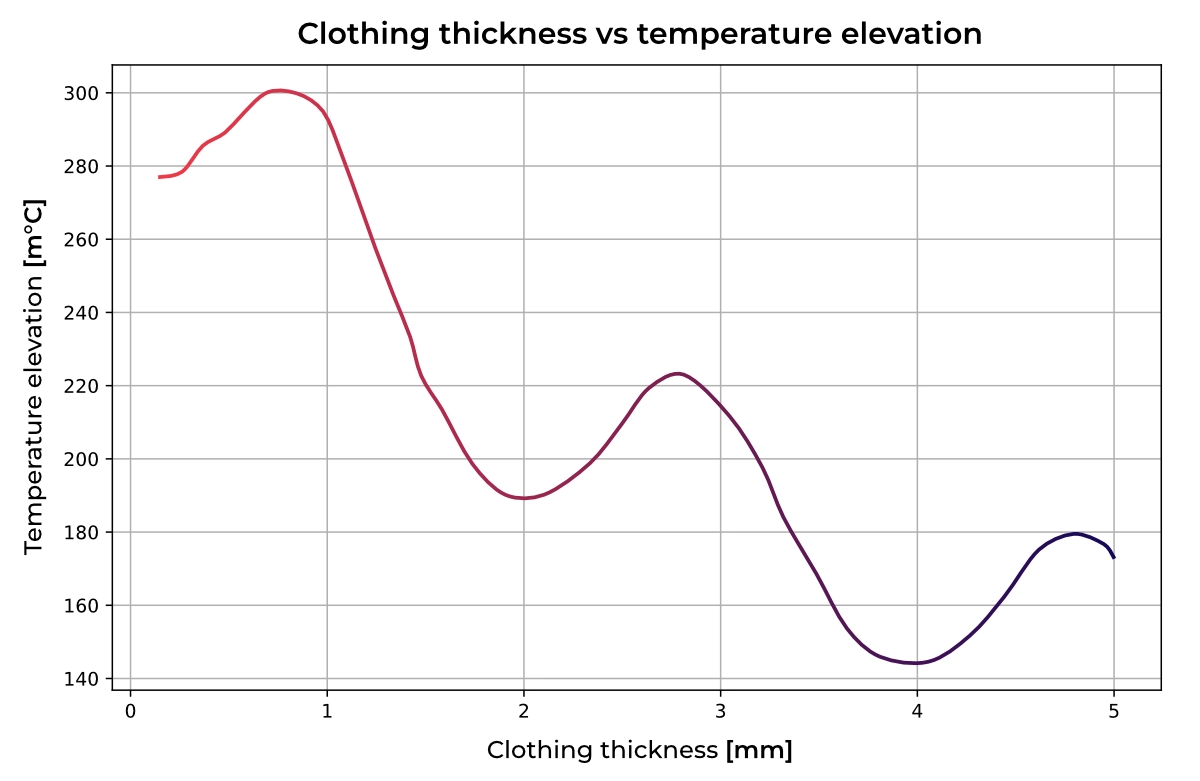
This effect is the highest on naked skin and decreases with overlayed elements of clothing.
Modern mmWave radars are designed to be low-power, energy-efficient devices, and usually have power outputs of no more than 100mW in peak transmission, far below regulated hazard levels. For comparison, the average output of the sun on the surface during a clear day is ~1000 W/m2, making the effects of regulated mmWave radiation negligible in comparison.
Eye absorption
A particularly sensitive part of the body, not covered by a protective layer of skin, are the eyes. Despite the fact that the skin absorption is far below hazardous levels and the radar output power being relatively small – the different cellular structure of eyes and their exposure to outside elements necessitates a careful study of mmWave effects on them. Furthermore, eyes have a limited blood flow which impairs normal heat dissipation. Various studies have examined ocular effects under different frequencies, power densities (PD), and exposure durations:
| Author |
Study target |
Study type |
Frequency (GHz) |
Power Density (mW/cm 2) |
Duration |
Results |
|---|---|---|---|---|---|---|
| Kues et al.6 | Nonhuman primate eyes | Low-intensity, long-duration exposure | 60 | 10 | 8h | No detectable ocular damage |
| Chalfin et al.7 | Nonhuman primate eyes | High-intensity, short-duration exposure | 35 | 2,000–7,000 | 1.5–5 s | Transient corneal lesions, reversible within 24 h |
| Rosenthal et al.8 | Rabbit eyes | Moderate exposure | 35/107 | 50 | 15–80 min | Transient corneal damage, began to recover on the next day |
| Kojima et al.9 | Rabbit eyes | Very high-intensity exposure | 60 | 1,898 | 6 min | Corneal edema and desiccation |
While mmWave radiation can cause damage to corneas and eyes, this is achieved under very specific situations where the subject is stimulated with very high energy beams, significantly higher than industry regulated maximum and for prolonged periods of time. Even in these specific scenarios the damage was minor and self-reversable under a short period of time.
Conclusion
The overwhelming number of studies done on simulations, animals and human subjects indicate that if adherent to current regulations and standards, the power outputs of mmWave radar are negligable in comparison to natural phenomena and the negative effects are non-existent.
The term “radiation” might be intimidating by itself, but in the context of mmWave radar it is significantly less dangerous than taking a stroll on a sunny spring day.
References
1 World Health Organization. 2023. “Ionizing Radiation and Health Effects.” www.who.int. WHO. July 27, 2023. https://www.who.int/news-room/fact-sheets/detail/ionizing-radiation-and-health-effects.
2 Lin, James C., and International Commission on Non-Ionizing Radiation Protection (ICNIRP). 2012. “ICNIRP Statement—Health Issues Associated with Millimeter Wave Whole Body Imaging Technology.” Health Physics 102 (1): 81–82. https://doi.org/10.1097/hp.0b013e31823a1278.
3 FCC. 1996. “Guidelines for Evaluating the Environmental Effects of Radiofrequency Radiation.” FCC.gov. Federal Communications Commision. August 1, 1996. https://www.fcc.gov/document/guidelines-evaluating-environmental-effects-radiofrequency.
4 Owda, A. Y., Salmon, N., Casson, A. J., & Owda, M. (2020). The Reflectance of Human Skin in the Millimeter-Wave Band. Sensors, 20(5), 1480. https://doi.org/10.3390/s20051480
5 Wu, T., Rappaport, T. S., & Collins, C. M. (2015). The human body and millimeter-wave wireless communication systems: Interactions and implications. 2015 IEEE International Conference on Communications (ICC). https://doi.org/10.1109/icc.2015.7248688
6 Kues, H A, S A D’Anna, R Osiander, W R Green, and J C Monahan. 1999. “Absence of Ocular Effects after Either Single or Repeated Exposure to 10 MW/Cm(2) from a 60 GHz CW Source.” Bioelectromagnetics 20 (8): 463–73. https://pubmed.ncbi.nlm.nih.gov/10559768/.
7 Chalfin, Steven, John A. D’Andrea, Paul D. Comeau, Michael E. Belt, and Donald J. Hatcher. 2002. “MILLIMETER WAVE ABSORPTION in the NONHUMAN PRIMATE EYE at 35 GHz and 94 GHz.” Health Physics 83 (1): 83–90. https://doi.org/10.1097/00004032-200207000-00009>.
8 D’Andrea, J. A., and S. Chalfin. 2000. “Effects of Microwave and Millimeter Wave Radiation on the Eye.” Radio Frequency Radiation Dosimetry and Its Relationship to the Biological Effects of Electromagnetic Fields, 395–402. https://doi.org/10.1007/978-94-011-4191-8_43.
9 Kojima, Masami, Masahiro Hanazawa, Yoko Yamashiro, Hiroshi Sasaki, Soichi Watanabe, Masao Taki, Yukihisa Suzuki, Akimasa Hirata, Yoshitsugu Kamimura, and Kazuyuki Sasaki. 2009. “ACUTE OCULAR INJURIES CAUSED by 60-GHZ MILLIMETER-WAVE EXPOSURE.” Health Physics 97 (3): 212–18. https://doi.org/10.1097/hp.0b013e3181abaa57.