Functional Safety for Industrial Radar Protective Devices
Functional safety
/ˈfʌŋkʃənəl ˈseɪfti/ noun
1. The part of overall safety that depends on a system or equipment operating correctly in response to its inputs, including the safe management of likely operator errors, hardware failures, and environmental changes.
- In industrial automation, functional safety ensures that machinery enters a safe state if a fault occurs.
Why Functional Safety Matters
In engineering, safety is not an afterthought, but a fundamental design principle. As systems increase in complexity—ranging from autonomous vehicles to industrial robotics—the assurance of safe operation under all conditions becomes paramount.
Functional safety is not necessarily a system of exact physical devices but a method of systematically approaching safety systems to ensure they continue to function safely even under unexpected failure events and return to a predefined safe state.
Core Principles
Functional safety is built on a systematic approach:
1. Hazard Identification
What could go wrong? This step involves analyzing the system for potential risks that could endanger people, the environment, or equipment.
2. Safety Functions
What must the system do to prevent those hazards? These are the automated functions designed to keep the system in or return it to a safe state.
3. Fault Handling
How does the system respond to failures? Redundancy, diagnostics, and a shutdown procedure ensure that the faults do not escalate into dangerous events.
4. Risk Reduction
Can the risk be lowered to a tolerable level? Functional safety provides a framework for ensuring residual risk is minimized and documented.
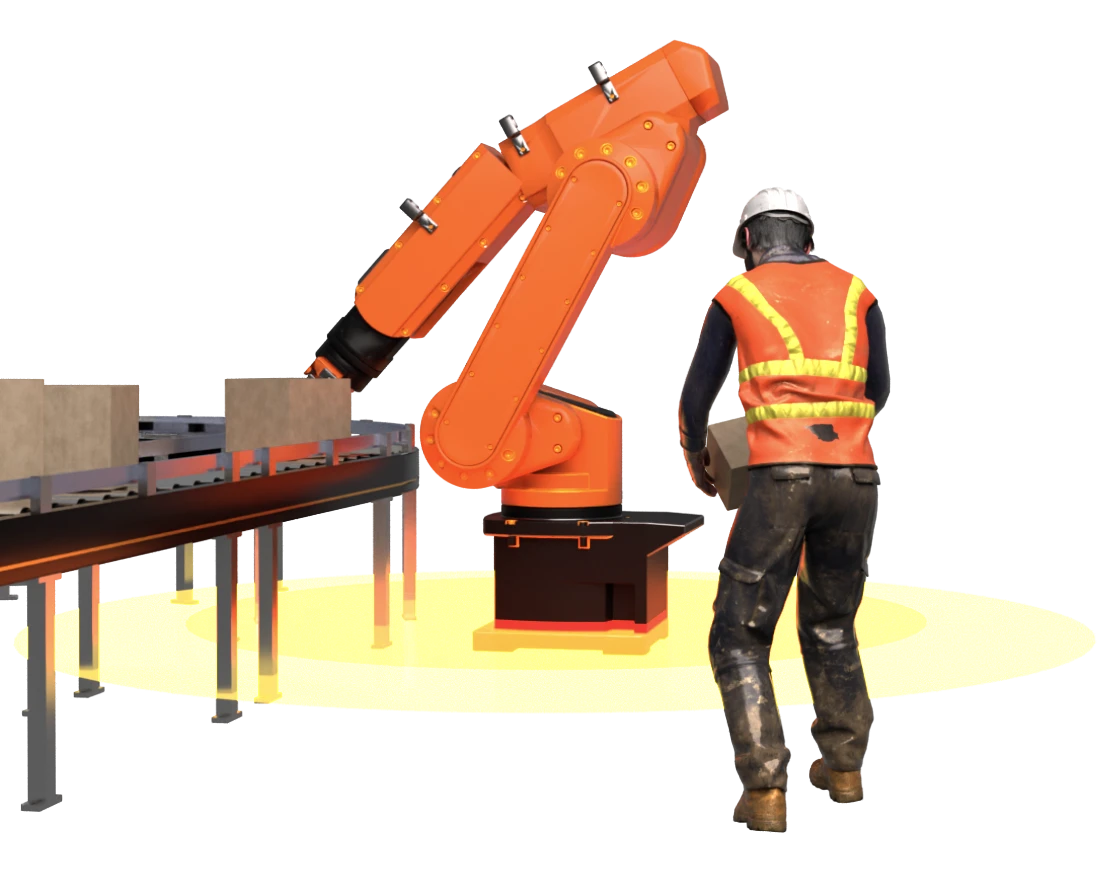
NOVELIC’s radar sensor detects intrusions within the safety zone, triggering a change of the OSSD (output signal switching device).
Standards and Frameworks
To ensure consistency across industries, international standards define the principles of functional safety. The foundation is IEC 61508, which establishes lifecycle processes for the design and assessment of safety-related systems.
From this general standard, industry-specific guidelines have evolved:
- ISO 26262 – Automotive functional safety
- IEC 62061 – Safety of machinery
- IEC 61496 – Electro-sensitive protective equipment
A central concept in these standards is the Safety Integrity Level (SIL) or, in the automotive industry, the Automotive Safety Integrity Level (ASIL). These levels classify how rigorous the design and verification process must be, depending on the severity of potential hazards.
Practical Examples
- In industrial automation, robots and machinery are designed to stop or switch to a safe mode if a sensor fails or a human enters a hazardous zone.
- In automotive systems, functional safety ensures that braking, steering, and airbag systems respond reliably, even if a component fails.
- In medical devices, monitoring equipment must raise alarms or fail safely if measurements cannot be guaranteed.
In all cases, functional safety is what allows users and regulators to trust that technology will not create unacceptable risks.
IEC TS 61496-5:2023 – Radar-Based Protective Devices
Specific to our application, IEC TS 61496-5:2023 is a recent industry standard defining the requirements for Radar Protective Devices (RPDs) in industrial environments. The standard applies to whole-body detection of adults, and covers radar systems operating in the 9 GHz to 81 GHz frequency range. Its primary objective is to ensure that these devices reliably detect human presence and respond appropriately, even under challenging conditions such as dust, low light, environmental interference, or partial occlusion.
The standard specifies verification across several domains:
- Response Time Tests
Measures how quickly the device reacts when a target, pedestrian or reflector, enters the detection zone to ensure safety. - Sensitivity and Stability Tests
Checks that the device consistently detects targets under normal operating conditions. - Environmental Tests
Ensures device performance is reliable under temperature changes, humidity, vibrations, shocks, and electrical disturbances. - Interference Tests
Verifies immunity to other signals, nearby devices, other RPDs, or irrelevant targets, in order to prevent detection of objects (false negatives) and prevent the degradation of system availability (false positives).
At NOVELIC, we rigorously adhere to all relevant international safety standards, ensuring that our systems meet or exceed industry requirements. From the earliest stages of design to final deployment, every component and process is evaluated for compliance with standards such as IEC 61508, ISO 13849-1, and the IEC 61496 series.
This comprehensive approach guarantees that our solutions not only perform reliably but also maintain the highest levels of functional safety, providing clients with confidence in both the effectiveness and regulatory compliance of our products.