BSIS & MOIS: The Adoption of Road Safety Systems in Commercial Vehicles
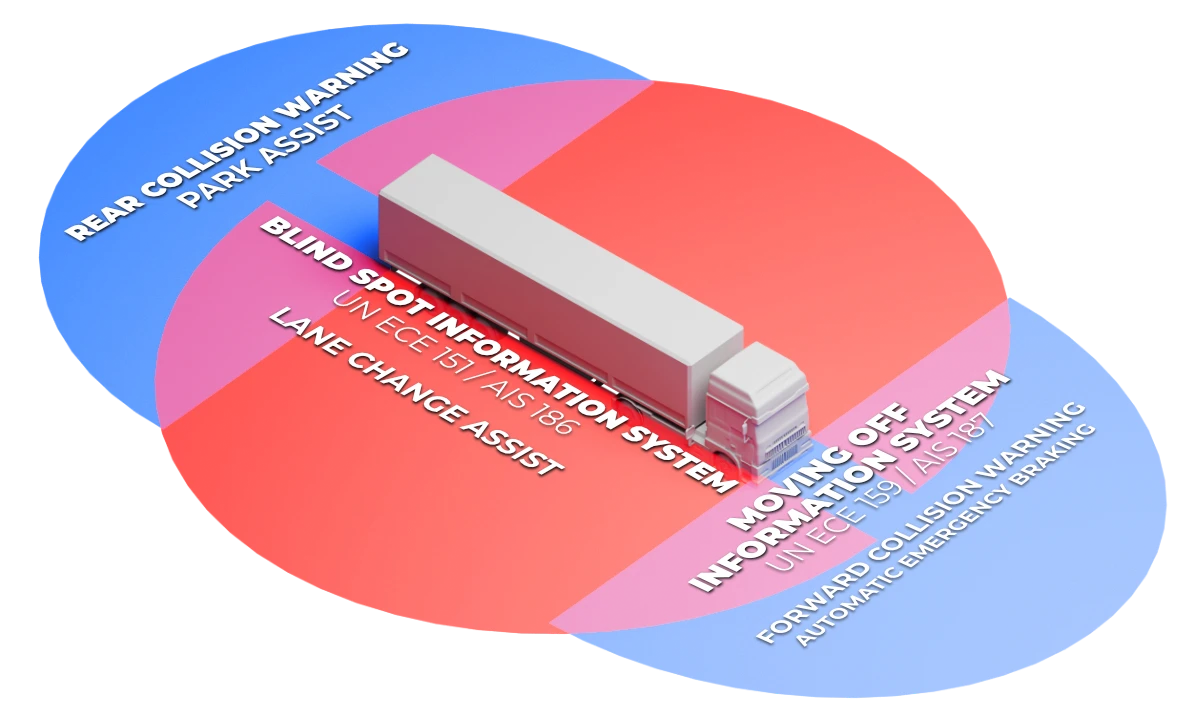
BSIS – Blind Spot Information System

BSIS is a safety system designed to detect people, cyclists, and other vehicles that appear in the driver’s blind spot — especially on the passenger side, where visibility is the weakest. Defined as any system designed to inform the driver of a possible collision with an object on the near side of the vehicle, it typically involves camera systems, LiDAR, Infrared, or mmWave radar.
Protecting Vulnerable Road Users (VRUs)
Cyclists, pedestrians, and scooter riders are the most at risk during truck turns or lane changes. Many urban accidents happen because a driver simply didn’t know someone was riding alongside the vehicle. BSIS reduces this risk by acting as an early-warning system. When the turn signal is activated, the alerts become more urgent, giving drivers the chance to react before a collision can occur.
UN Regulation No. 151
The United Nations Economic Commission for Europe (UNECE) provides a framework for Vehicle Regulations. Specifically, UN Regulation No. 151 defines a set of tests that a system needs to fulfill in order to be considered a valid BSIS System. It defines mandatory monitored zones along the nearside of the vehicle, and a requirement for a visual auditory warning whenever an object is located within. The system also must avoid false alarms.
MOIS – Moving Off Information System

MOIS is a forward-looking safety feature designed to help drivers detect vulnerable road users positioned directly in front of a heavy vehicle during initial movement from rest. Due to limited visibility of the front blind area, a MOIS uses sensing technologies — such as cameras, radar, infrared, or LiDAR — to monitor this critical zone and provide timely driver notifications of potential collisions.
Enhancing Safety at Low Speeds
Accidents frequently occur at intersections or pedestrian crossings, when a vehicle begins to pull away and the driver is unaware of a person or cyclist standing close to the front bumper. MOIS addresses this issue by supervising the forward proximity area and issuing clear warnings before the vehicle starts to move. The intention is to give the driver immediate awareness of obstacles that would otherwise be hidden from view, helping prevent collisions in crowded urban environments.
UN Regulation No. 159
Within the UNECE framework, UN Regulation No. 159 describes how a compliant MOIS must behave. It specifies the required detection zone in front of the vehicle, outlines how the system should inform the driver through visual and, when appropriate, audible alerts, and sets minimum functional performance thresholds. R159 also emphasizes system reliability, including resistance to false positives and the ability to operate correctly under varied environmental conditions.
TRS – Reversing Information / Rear Detection System

Truck Reverse Sensing is a system designed to monitor the rear area of a heavy vehicle while it is reversing, helping the driver identify obstacles, pedestrians, or other road users that may be obscured behind the vehicle. Due to the height and length of trucks, rear visibility is often extremely limited; reverse sensing technologies—typically ultrasonic sensors, radar units, or rear-mounted cameras—provide essential situational awareness during backward maneuvers.
Improving Safety During Reversing Maneuvers
Rear-end incidents are common in depots, loading zones, and urban streets where pedestrians or small objects may be hidden directly behind the vehicle. Reverse Sensing systems address this challenge by tracking the space immediately to the rear and issuing alerts when a person or obstruction is detected. These warnings assist drivers in performing slow-speed reversing with greater confidence, reducing the likelihood of collisions in confined or busy areas.
Regulatory Context — UN Regulation No. 158
Under the UNECE regulatory framework, UN Regulation No. 158 outlines the requirements for Reversing Information Systems used on heavy vehicles. R158 defines the rear detection zone, specifies the minimum sensing coverage, and stipulates how the system must inform the driver—typically through a visual display, supplemented by audible signals when necessary. The regulation also includes performance tests to ensure reliable detection of standardized pedestrian targets and requires systems to function consistently across a range of operating conditions while limiting nuisance warnings.
mmWave radar as a safety system
Environmental factors, such as mud, rain and snow, can degrade the performance of sensors that rely on a visual line of sight. This gives radar systems a critical advantage, as they are capable of sensing through various obstacles that can otherwise completely hinder the functionality of other sensors. This has made 77-81 GHz radar sensors a popular cost-effective and robust solution to fulfill this need.
Present day radar solutions require the use of two or more modules to cover the full field of view required for BSIS and MOIS. Compared to existing products on the market, NOVELIC’s ASPER sensor is significantly smaller, while achieving a wide 180° field-of-view with only one radar chip. The solution offers on-module radar data processing, allowing for easier integration and overall lower system costs for vehicles that may not necessarily have zonal controllers, or a CAN network in place.
The same module is used for blind spot monitoring, lane change assist, moving-off information systems, and front/rear collision warnings for semi-trailer trucks, buses, dump trucks and more.

International regulation and adoption
Many major automotive regions have aligned with the UNECE regulatory framework, adopting standards such as UN R151 (BSIS), UN R159 (MOIS), and UN R158 (Reversing Information Systems). The European Union, Japan, South Korea, India (designated under the AIS 186 and AIS 187 standards), Australia (ADR 105, ADR 106, and ADR 108) and several other contracting parties have fully integrated these requirements into their type-approval processes
China, as a rapidly growing leader in the automotive industry, follows its own regulatory framework built around the GB standards. These standards outline performance and testing requirements for a wide range of vehicle technologies, including Advanced Driver Assistance Systems (ADAS), Driver Monitoring Systems (DMS), and other safety-critical driver-support functions.
The United States has not yet implemented dedicated regulations for these specific systems. However, industry trends and ongoing safety discussions suggest that similar standards may emerge in the near future as states push for stronger protection of vulnerable road users. The recent requirement of Automatic Emergency Braking (AEB) as standard equipment by the NHTSA indicates that the adoption of other assistance systems is in consideration.